

Archive: The Railway Magazine, October 1969
In August 1969, a new British Railways service began carrying molten iron between Middlesbrough and Consett using specially-designed torpedo cars. This original report from The Railway Magazine describes the locomotives, rolling stock, route and early operating difficulties.
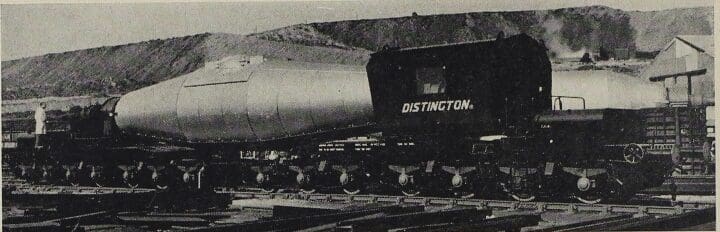
Photo: Distington Engineering Co. Ltd.
FOR the first time over an appreciable distance on British Railways, a daily service of trains carrying hot metal has been introduced between Teesside and Northwest Durham. Three specially-designed “torpedo” cars, each carrying a maximum of 100 tons of molten iron, inaugurated a regular 63-mile service between Cargo Fleet Works, Middlesbrough, and Consett Works, Durham, on August 4.
Enjoy more The Railway Magazine reading every month.
Click here to subscribe & save.
The purpose of the new service
The project, planned by the Iron & Steel Corporation in co-operation with B.R., provides iron needed to maintain steel production while blastfurnaces are being rebuilt and ultimately will secure full potential output of the basic oxygen steel plant at Consett.
Locomotives and rolling stock
Each train comprises two English Electric class “37” 1,750-h.p. diesel locomotives working in multiple, three torpedo wagons, and three spacer vehicles between them to distribute the load over bridges.
The torpedo cars were designed and built to British Railways requirements by the Distington Engineering Co. Ltd. (B.S.C. Midland Group) in association with Demag AG. Each runs on 14 axles and weighs approximately 241 tons fully laden. Overall length is 84 ft. 8 in. The vessel is sealed with a special lid and has a 15-in. layer of insulation. The outer skin of the vessel is further shielded by steel plate.
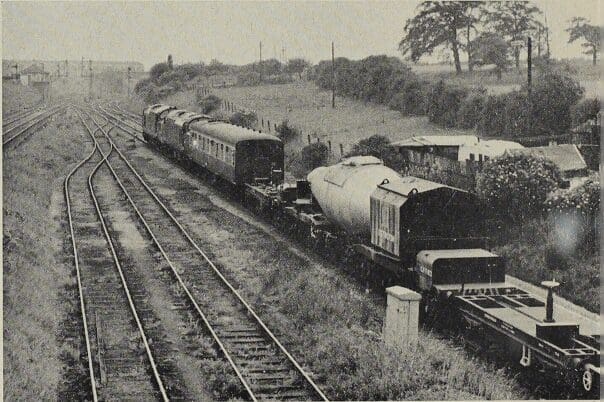
Photo: J. S. Carr
Route and operating arrangements
Initially, the train (6X93) was departing from Cargo Fleet at 12.30 and routed through Tees Yard, Stockton, Stillington, Ferryhill, Leamside lines, Washington, Pelaw, Gateshead, Team Valley main line and Beamish to Consett Low Yard, whence it returned at 20.35, but during September it was expected that the trips would be increased to two daily, Saturdays and Sundays included. For the first week of operation, Western Region dynamometer car No. 4 (converted and equipped in 1961 from a former Hawksworth third-class coach, built in 1946) now No. DW150192, was marshalled at the front of the load for various measurements to be taken.
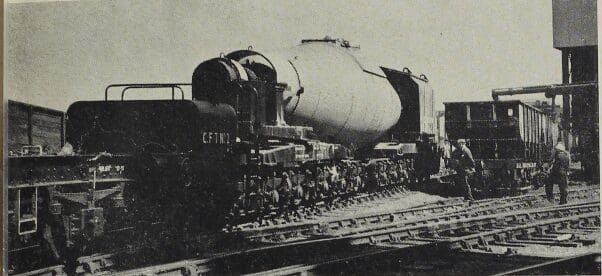
Photos: John M. Boyes
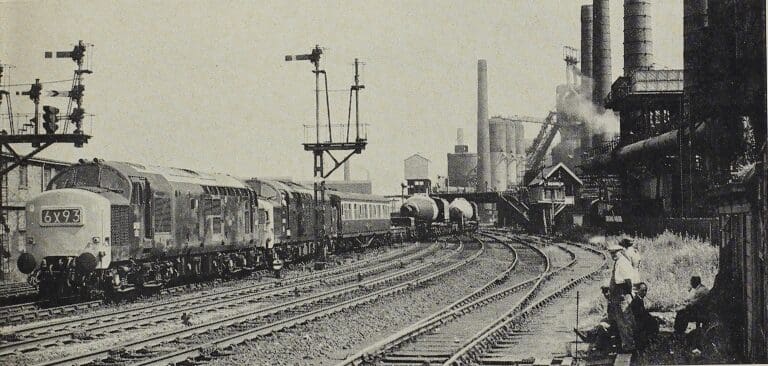
Early operational difficulties
On the inaugural day of operation, August 4, only two torpedo wagons returned from Consett because the “cap” on the top of one jammed during the unloading operation and it had to remain there overnight. A week later the service had to be completely withdrawn temporarily for modifications to be made to the torpedo containers.
Speed restrictions
The speed of the train is limited to 20 m.p.h. maximum loaded, and 35 m.p.h. empty, though in both cases there are other restrictions which limit speed even further, some concerned with the fact that it has to be run as an “out-of-gauge” load.

