In the July 1979 issue of The Railway Magazine, O. S. Nock described an attempt by Western Region to set a world record for start-to-stop average speed by train. The run involved the 09.20 HST from Paddington on April 10, 1979, with the speed limits throughout to be strictly observed.
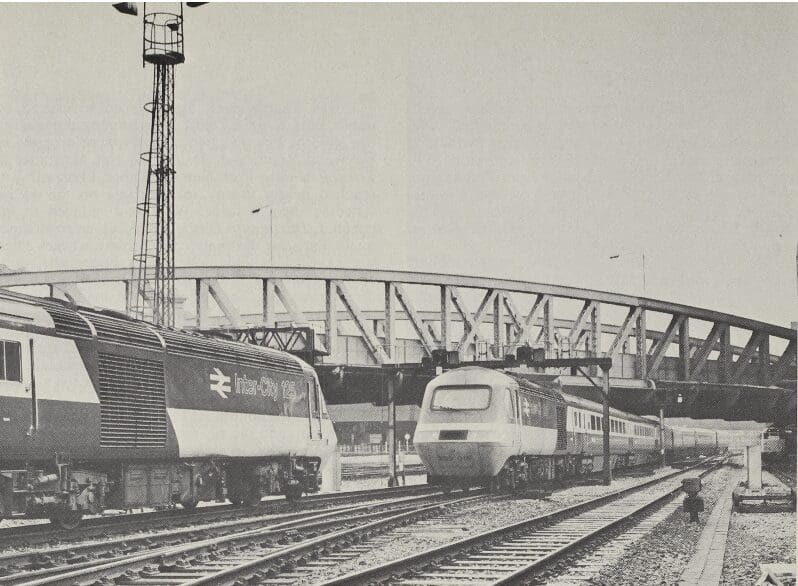
NEW WORLD RECORD
O. S. NOCK, BSc, CEng, FICE, FIMechE
Enjoy more The Railway Magazine reading every month.
Click here to subscribe & save.
The record attempt
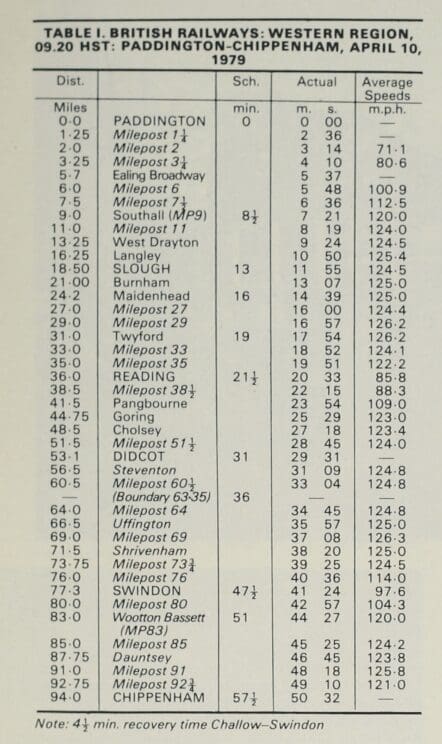
WHEN the Western Region advised me that an attempt was going to be made on the world record for a start-to-stop average speed by train, and invited me to log the running, I suppose my feelings were much the same as those of my distinguished predecessors prior to July 14, 1903, and June 5, 1932, when on the first occasion Charles Rous-Marten and the Rev. W. J. Scott were invited to accompany the Royal advance portion of the down “Cornishman”, and on the second Cecil J. Allen and Humphrey Baker were to log the “Cheltenham Flyer”—both to prove outstanding Great Western occasions. But there was a vast difference on April 10, 1979, when the train selected was the 09.20 HST from Paddington. It so happened that in that particular week there were no engineering slacks on the line; the earlier restriction over the junction at Wootton Bassett had been removed, and only the permanent speed restrictions to 80 m.p.h. at Reading and 100 m.p.h. at Swindon remained to interrupt continuous running at 125 m.p.h. right through to the first stop at Chippenham. So Western Region decided to “have a go”.
Running to Wootton Bassett
A controlling factor would of course be the running of the 09.15 HST, non-stop from Paddington to Swansea. This train is booked to run 5 min. ahead of the 09.20 to Wootton Bassett, but both have 4½ min. recovery time between Challow and Swindon, and in the absence of any temporary slacks there would ordinarily have been some justification for easing down a little. Instructions were therefore given to the crew of the 09.15 to run up to full recovery standards—and a little more!—out to Wootton Bassett to keep well out of our way; so that in fact there would be not one but two trains making record time that morning. It was, however, not a case of going as hard as was practicable. The speed limits, not only at Reading and Swindon, but throughout, were to be strictly observed, even more so in fact than on the Inter-City 125 “Jubilee Special” of May 7, 1977, when sustained speeds up to 128 m.p.h. were run. Had even such a slight indulgence as this been permitted the times we made could have been even faster. But on April 10, 1979, it was the remarkable precision of the running that lent such distinction to the performance. No less remarkable however is the way in which the working on April 10 bears correspondence to ordinary day-to-day performance on the HST services. On my very last down journey previous to the record run our times from Milepost 9 to 31, and from 56½ to 76, were only 7 and 4 sec. longer respectively.²
The April 10 run
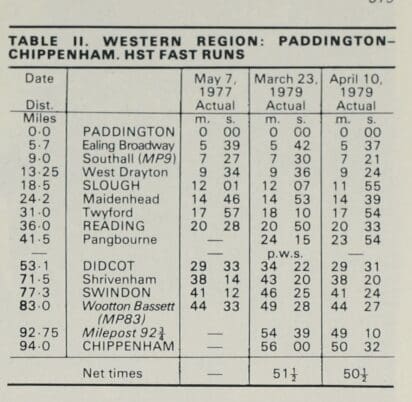
Now, as to April 10, the train left from Platform 7 at Paddington, and was consequently a little slower than it might have been from 3 or 4; but we soon settled down to an immaculately even pace. Complete details are set out in Table I, while in Table II are shown alongside details of the “Jubilee Special”, and of my own run with the 17.20 from Paddington on March 23, 1979. Because of the slightly higher maximum speed the “Jubilee Special” had drawn a little ahead by Reading; but speed was reduced to 76 m.p.h. there, and the times fell slightly behind for a while, only to take the lead again approaching Swindon. On my own ordinary journey on March 23 the slight restriction at Wootton Bassett was still observed; but there was a very fast finish, with high speed maintained to within a mile of Chippenham. On the preliminary note concerning the record run, published last month, the average speed was quoted as 111·6 m.p.h. for 94 miles. This latter is the usual mileage quoted for Chippenham, the milepost itself being just beneath the footbridge leading to that part of the town north of the railway—not the inter-platform footbridge of the station itself. To be strictly accurate however the distance actually travelled from start to stop was 93·94 miles, and this reduces the average speed to 111·55 m.p.h.
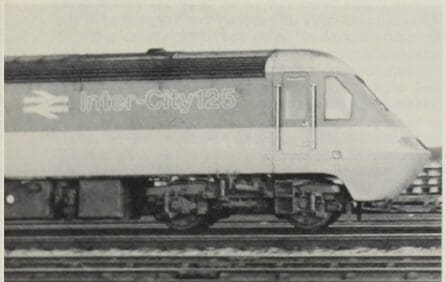
Photo: Paul J. Lambeth
Comparing the record
The highest average speed that I have personally recorded anywhere in the world for a start-to-stop run was on the Japanese New Tokaido line, from Tokyo to Nagoya, 213·5 miles at 106·7 m.p.h. This particular run is scheduled in 123 min. at 104 m.p.h. start-to-stop. It is of course probable that faster runs than my own, in 120 min. 15 sec., have actually been made, though it would need a run in 114 min., 9 min. inside schedule, to equal the HST average speed of April 10, 1979. Thus, so far as known records are concerned, the Western Region of British Railways holds the world’s record by a substantial margin.
A second record run
Just to show, however, that this was no mere flash in the pan, little more than a fortnight later their new record was fractionally beaten. On Friday, April 27, the 17.20 from Paddington was required to make a special stop at Reading, from which the 58·0 miles to Chippenham were covered in 31 min. 10 sec. start to stop, an average of 111·68 m.p.h. Details of this run, for which I am indebted to Mr. D. J. Huntley, show that Didcot, 17·1 miles, was passed in 16 min. 16 sec.; Swindon, 41·3 miles, in 21 min. 58 sec., and that the average speed over the 53·95 miles from Tilehurst to Langley Crossing was a little over 120 m.p.h.