In September 1963, The Railway Magazine took a detailed look at Healey Mills, the new marshalling yard four miles west of Wakefield on the Calder Valley route to Manchester. The article described a yard capable of handling 4,000 wagons a day, with 120 sidings totalling 57 miles of track.
HEALEY MILLS, four miles west of Wakefield on the Calder Valley route to Manchester, is the natural concentration point for east-west freight traffic between the highly industrial West Riding of Yorkshire with the East Coast ports of Hull and Goole, the industrial areas of Lancashire and the Merseyside ports. It is also a convenient “half-way house” between the heavy industrial area of the North-East and Lancashire. The marshalling of this east-west traffic was previously carried out in 13 separate small shunting yards with out-dated and inadequate facilities and the construction of the Healey Mills marshalling yard overcomes their uneconomic operation and provides the necessary concentration.
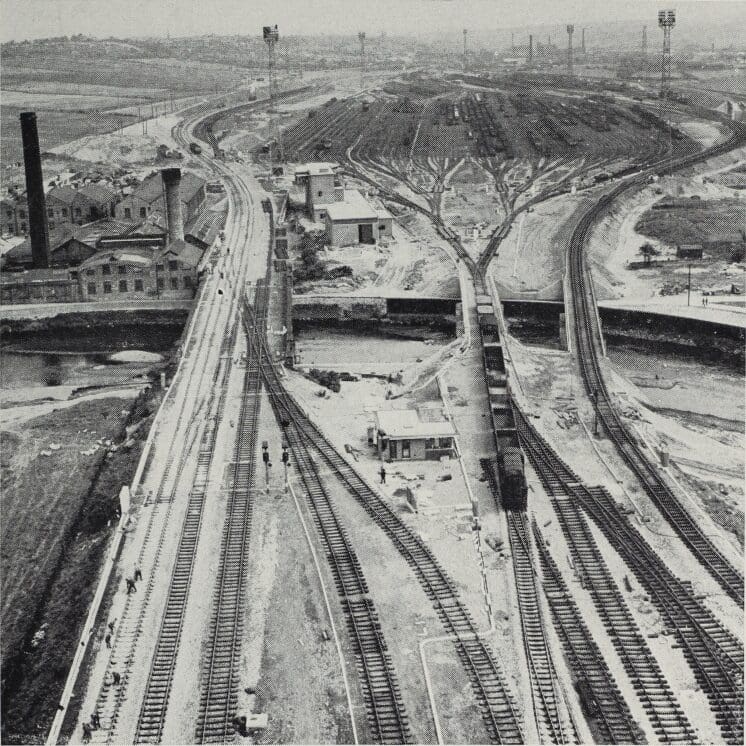
A new marshalling yard for the North Eastern Region
The third of three modern marshalling yards in the North Eastern Region—Tees yard came into operation in May and Tyne yard in June—Healey Mills was officially opened by Lord Robens on July 23, and a fourth major yard, at Stourton, is under consideration.
Enjoy more The Railway Magazine reading every month.
Click here to subscribe & save.
Capable of handling 4,000 wagons a day, a large proportion of which will have their transit times substantially reduced, and working in conjunction with other modern marshalling yards in the North Eastern Region and elsewhere on the British Railways system, Healey Mills Yard will not only make a substantial contribution to a greatly improved pattern of scheduled freight train services, but will also ensure these services being used more fully, more efficiently and more economically. About half the new yard’s traffic will be coal, much of it moving in train loads direct from the point of origin to the consumer. Freight requiring to be moved by “wagon” units rather than “train” units will be the prime concern of the yard, providing speedy and efficient sorting and marshalling.
Building the 140-acre site
Work on the 140-acre site in the Wakefield area began in 1959 and involved the re-siting and re-building of the Storrs Hill Road bridge, the diversion of 1,030 yd. of the River Calder, the removal of a sewage disposal works and the filling-in of an old mill reservoir, the diversion of the private roadway to Wilson Brigg’s Mill, the construction of three bridges to carry railway tracks over the river, the diversion of gas mains, the taking of high-voltage overhead cables underground and other ancillary works.
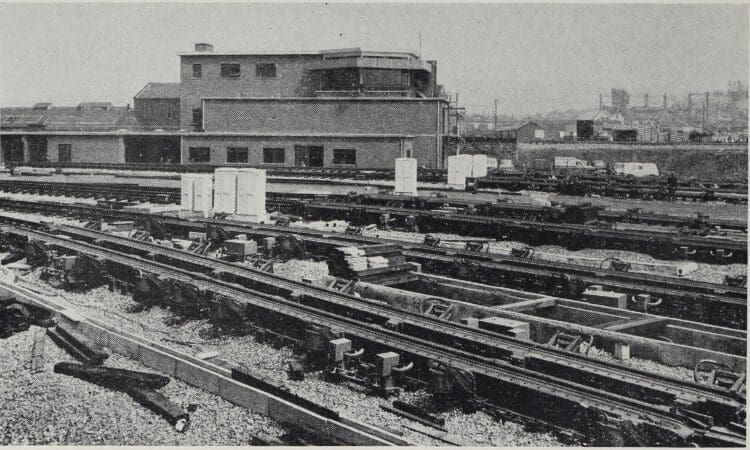
Altogether the yard contains 120 sidings, totalling 57 miles of track and includes 14 reception sidings leading to the hump, 50 main and 25 secondary sorting sidings, 15 staging sidings and 13 departure sidings. From the elevated control tower constant communication between yard staff and shunting locomotives is maintained, and a power-operated signalbox controlling movement over 7½ miles of adjacent running line is incorporated in it. Points are power-operated by switches housed in a console together with a diagram giving visual indication of the wagons in the switching areas.
Sorting and assembling trains
Wagons entering the yard are sorted into groups for particular destinations and accumulated to make up trains to take them on their way, each arriving wagon being connected with the first available forward service in accordance with a train service plan. A monitoring system achieves this through two charts, currently adjusted, located in the control tower. The reception planning chart enables the systematic selection of the order in which arriving trains are to be sorted and the sorting area chart enables the controller to follow in detail the accumulating wagons and the assembly of each train.
The hump and retarding equipment
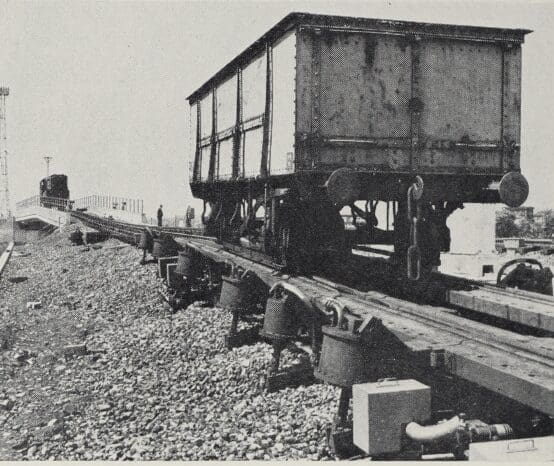
Being a “hump” yard, gravity is used for the running of wagons into their respective sidings, primary shunting taking place over one hump, with arrivals and departures possible in both directions. Designated as a “semi-automatic yard”, wagons to be sorted are released at the crest of the hump, their speed being controlled by passing over an automatic primary retarder. Later they traverse one of a series of secondary retarders. From each of the latter there are six selectable “leaving speeds”, the operator taking into account such features as rollability and weight and siding occupation. Wagon retarding equipment includes two fully automatic primary retarders each 65 ft. long and eight semi-automatic secondary retarders each 75 ft. long. Illumination of the yard is provided by eight 150-ft. floodlighting towers. Power for points and retarders is supplied from compressors sited in, but insulated from, the control tower building.
Signalling and communications
The main signalling installation controls entry into and egress from the yard and each route, when set, is indicated on the “maps”, signal and point indications being indicated geographically. The main installation consists of 464 routes, controlling 58 main colour-light signals, 81 subsidiary signals, 120 points and 334 track circuits. The signalling installation for the yard itself comprises an elevated three-aspect double-sided hump signal controlling movement over the hump and two-aspect “position-light” ground signals which control movement from the reception sidings. A highly-efficient inter-communication system is installed to provide contact between all points in the yard together with a “talk-back” loudspeaker system, while radio telephone provides communication between the control tower and shunting locomotives. Hump signal aspects are also repeated in miniature in the locomotive cab.
Re-using railway infrastructure
In the process of marrying the 13 old yards into one, 43 miles of the total of 57 miles of track was recovered from abandoned lines and the main span of the fly-over line was built from the two lattice girders recovered from the bridge which used to carry the main lines over the old mill reservoir. The access footbridge to the administration block was made up from serviceable lengths recovered from the 120-ft. footbridge which formerly crossed the lines at the north end of Darlington Station. In such a way does the old serve the new in the Healey Mills marshalling yard, the construction of which involved an expenditure of £3¼ m. and took nearly three and a half years to complete.
The original story appeared in The Railway Magazine and is accessible in the online archive, for Railway Magazine subscribers. Click HERE to subscribe, save and access!